A disciplined digital workflow in forensic photography shapes how forensic photographers, analysts, and examiners now capture, process, and preserve critical visual evidence. Modern, streamlined digital tools deliver improved accuracy and reliability versus older practices—a vital transformation for courtroom success (NIST Guidelines).
The Era of Film Photography: Challenges and Limitations
Before digital systems, only specialized forensic photographers or examiners handled scene documentation. Analog photography demanded careful pre-planning, deep technical knowledge, and physical expertise. Equipment was heavy; technical errors—such as misloading film or misfiring flashes—were common. Images frequently arrived at the lab underexposed or overexposed, and mistakes caught post-development left scenes unrecoverable (History of Forensic Photography).
The Digital Revolution in Forensic Photography
Today, digital cameras and smartphones enable forensic analysts to immediately review and adjust photographs. Automatic exposure controls and digital storage removed technical and cost barriers. Now, not just specialists, but most officers, are required to photograph scenes and evidence, accelerating documentation and chain of custody (Best Practices in Field Documentation).
Smartphones: Capabilities and Limitations
Smartphones improve response time, but forensic examiners must be aware of their limitations. Their resolution is typically insufficient for detailed enlargement or rigorous court analysis (Forensic Imaging Limitations). Many default settings compress files, reducing critical detail, and low-light performance remains inadequate for complex or night scenes. For major investigations, professional digital cameras with external strobes remain the standard (IAI Certification).
Field Capture Protocols for Forensic Photography
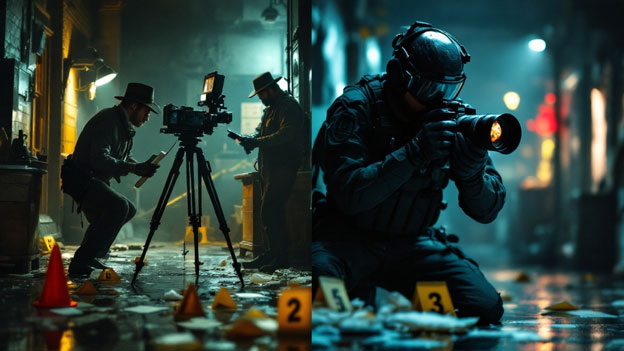
Every device used must follow strict field capture protocols. Start with overall photos, proceed to mid-range and detailed close-up shots, and ensure all photographic evidence includes clearly placed scales. Oblique lighting enhances ridge detail, while proper gloves help prevent evidence contamination. Multiple angles ensure no detail is lost or left undocumented (NIST Evidence Protocols).
Processing and Digital Enhancement
Raw digital images should be properly enhanced prior to court use. Forensic analysts adjust contrast, clarify ridge detail, and reduce background noise using specialized software (NIJ Digital Processing Guidelines). Every adjustment is documented with timestamps and operator notes to maintain the verifiable chain of custody.
Advanced methods, such as infrared and ultraviolet imaging, reveal detail missed by standard photographs. Certified experts ensure all enhancements meet laboratory and court standards.
Secure Archiving and Long-Term Preservation
Secure digital archiving is vital (NIST Digital Evidence Guidelines). Original files plus metadata are encrypted and backed up, access-controlled, and maintained for years. Proper archiving supports cold case re-investigation—something impossible with deteriorating film. Digital images can be reviewed indefinitely as new technology emerges.
Training, Legal Standards, and Expert Testimony
Ongoing forensic photography training is essential. Under Federal Rules of Evidence 702, only well-qualified experts employing validated methodology may testify. Certifications and documentation support admissibility and case credibility. Forensic examiners who are IAI Certified Forensic Photographers provide confidence in both image authenticity and the underlying process.
Conclusion
A robust digital workflow in forensic photography ensures that crime scene and evidence images are captured, processed, and archived in a manner that meets the highest legal and scientific standards. While smartphones add flexibility, major cases demand the rigor of advanced digital cameras and certified experts. Disciplined digital workflows protect evidence integrity, support cold case reviews, and ensure long-term reliability in court.
About the Author
by Kourosh Nikoui | September 14, 2025 | Latent Prints
Forensic Practitioner and Specialist Kourosh Nikoui is the Principal Consultant and CEO of Nikoui & Associates, Forensic Identification Services & Consulting, Inc. With more than 40 years of dedicated, full-time experience in forensic science and criminal justice, Mr. Nikoui has collaborated with law enforcement agencies, government bodies, and private entities. He is a court-qualified expert, Certified Latent Print Examiner, Certified Senior Crime Scene Analyst, and Certified Forensic Photographer—credentials awarded by the International Association for Identification.
Mr. Nikoui has provided expert witness testimony in over 150 hearings in California Superior and U.S. Federal Courts, processed evidence in over 30,000 criminal and civil cases, and has served as a consultant to numerous law enforcement agencies. He holds a BFA degree from USD and is an active member of multiple leading forensic science organizations.
For expert assistance, contact Mr. Nikoui directly at (866) 439-6753 or email [email protected]. To learn more,
visit www.nikouiandassociates.com.