

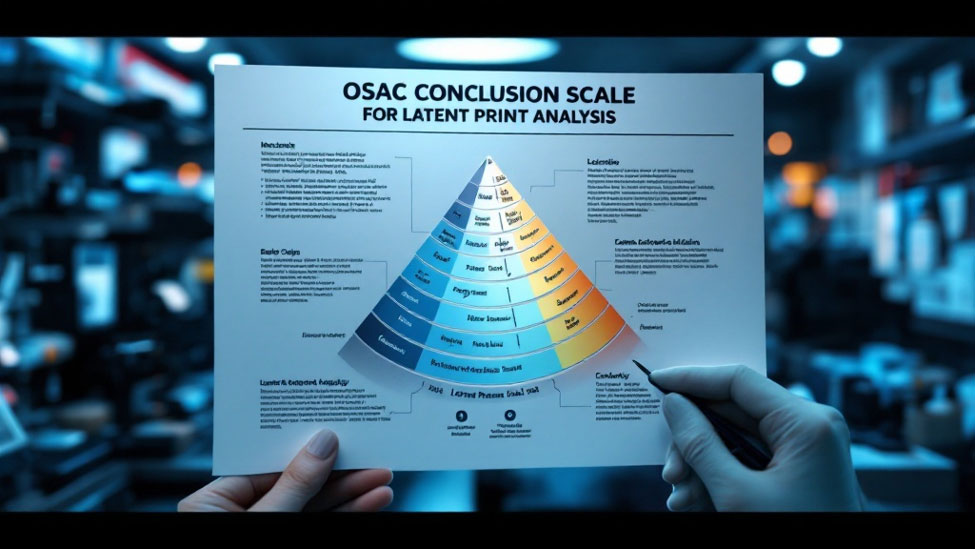
The OSAC Conclusion Scale is transforming how forensic experts report findings in latent print analysis. This powerful framework adds clarity and objectivity to evaluations—supporting precise and defensible testimony in court. In this article, we’ll explain the OSAC Conclusion Scale, its nine conclusion levels, practical reporting strategies, and why its adoption benefits criminal justice.
What is the OSAC Conclusion Scale?
The OSAC Conclusion Scale, managed by the Organization of Scientific Area Committees for Forensic Science (OSAC), sets a new standard in forensic fingerprint analysis. This scale moves beyond binary match or non-match reports. It uses nine defined levels. Each level provides nuanced evidence strength for latent print comparison and identification.
Key Goals of OSAC’s Scale
OSAC Conclusion Scale: The Nine Levels
Each level articulates evidence strength:
Why Choose the OSAC Conclusion Scale?
This scale gives forensic experts and courts a structured method for evidence evaluation. Transitioning from subjective opinions to reproducible, evidence-driven conclusions increases professionalism. It provides transparent, logical, and detailed explanations.
Read more about ACE-V method analysis and documentation →
The Scale in Action: A Forensic Case Example
Imagine a burglary case. A certified latent print examiner compares a latent print against a suspect’s known print. Numerous irreconcilable differences? The examiner reports “Extremely Strong Support for Exclusion.” Almost complete agreement? “Extremely Strong Support for Identification.” When features partly agree, “Moderate” or “Limited” conclusions apply. Insufficient clarity? The examiner selects “Inconclusive.”
Reporting and Testimony: Best Practices
Advantages Over Binary Reporting Systems
Binary reporting can lead to confusion. The OSAC Conclusion Scale uses a graduated approach. As a result, reports become more defensible and transparent. Jurors and judges gain real insight into evidence strength and limitations. This method reduces overstatement risk and addresses scientific standards—making your forensic services more credible.
Learn more: National Institute of Standards and Technology (NIST) resources on forensic standards
Criteria, Thresholds, and Application
To reach each scale level, forensic analysts assess:
Only when evidence surpasses strict thresholds will an expert assign “Strong” or “Extremely Strong” support. Otherwise, mid-to-low levels reflect the nuances—or limitations—of the current case.
Tips for Forensic Professionals
Final Thoughts: OSAC and the Future of Forensic Evidence
Adopting the OSAC Conclusion Scale signals commitment to clarity and credibility in forensic fingerprint analysis. With structured reports, defensible testimony, and impartial evaluation, your work stands up to scrutiny every time. Law firms and agencies benefit when they choose a forensic fingerprint analyst whose reports align with national standards.
Explore more about admissibility and expert testimony
About the Author
by Kourosh Nikoui | 09/01/2025 | Latent Prints
Forensic Practitioner and Specialist Kourosh Nikoui is the Principal Consultant and CEO of Nikoui & Associates, Forensic Identification Services & Consulting, Inc. With more than 40 years of dedicated, full-time experience in forensic science and criminal justice, Mr. Nikoui has collaborated with law enforcement agencies, government bodies, and private entities. He is a court-qualified expert, Certified Latent Print Examiner, Certified Senior Crime Scene Analyst, and Certified Forensic Photographer—credentials awarded by the International Association for Identification.
Mr. Nikoui has provided expert witness testimony in over 150 hearings in California Superior and U.S. Federal Courts, processed evidence in over 30,000 criminal and civil cases, and has served as a consultant to numerous law enforcement agencies. He holds a BFA degree from USD and is an active member of multiple leading forensic science organizations.
For expert assistance, contact Mr. Nikoui directly at (866) 439-6753 or email [email protected]. To learn more, visit www.nikouiandassociates.com.